
Legal AI Governance Report: What Audit-Ready Contract Review Will Require in 2026
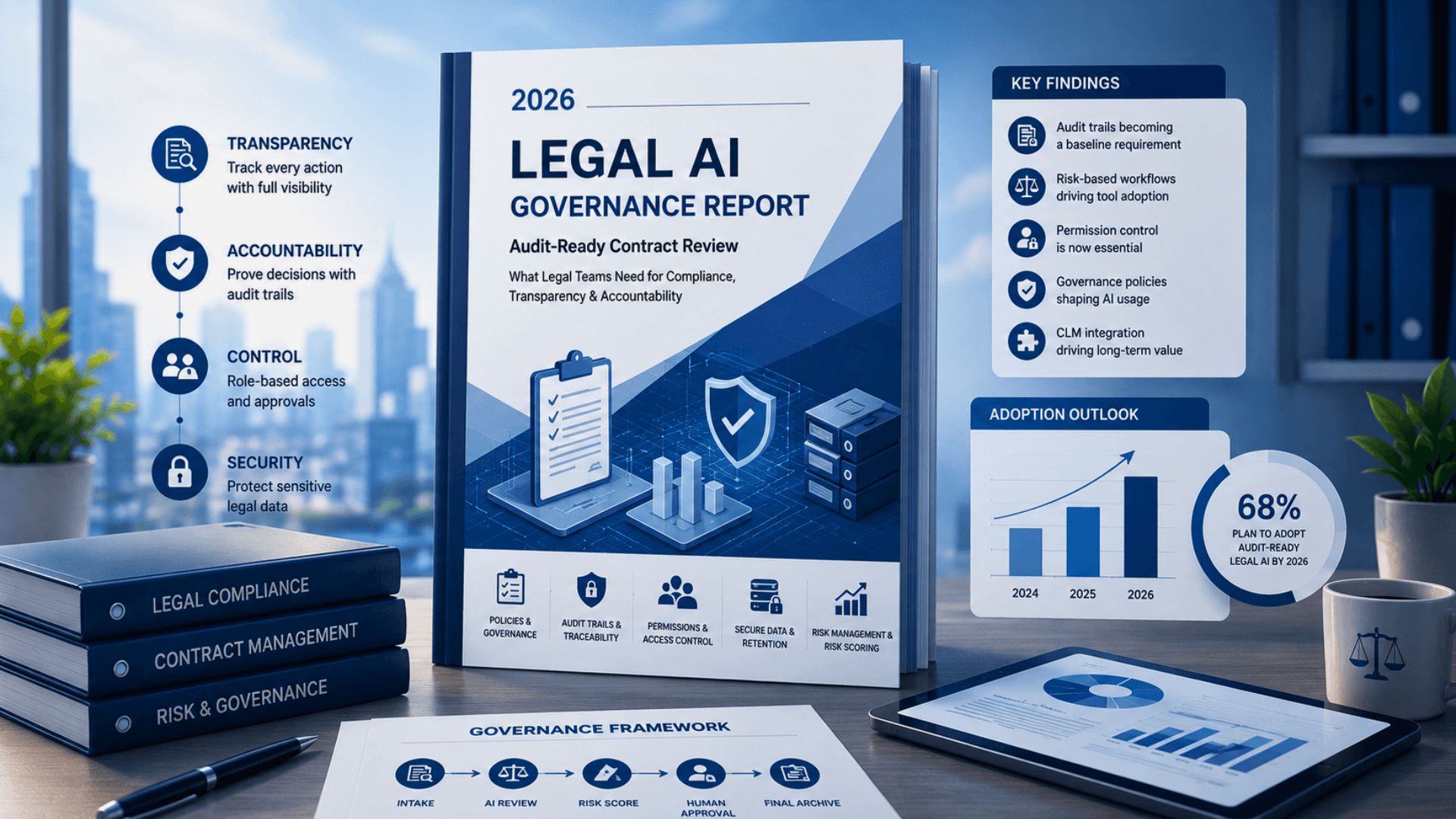
Legal AI adoption is becoming dependent on governance systems, not output quality alone.
Executive Summary
Legal AI adoption is entering a governance-driven phase.
In 2026, contract review tools will be evaluated less on drafting quality and more on whether they can support controlled workflows. This includes audit trails, permission systems, approval checkpoints, and defensible documentation.
As legal AI becomes embedded in procurement and commercial review processes, the expectation will shift from “useful assistance” to “audit-ready infrastructure.”
Key Findings
- Audit trails are becoming a baseline requirement in legal AI evaluation
- Risk scoring workflows are replacing general summaries
- Permission control is now critical for trust and vendor governance
- Governance policies are becoming part of standard contract operations
- Integration with CLM systems will become a major adoption driver
What Audit-Ready Legal AI Will Require
Audit-ready contract review systems will need to support four major pillars.
1) Traceability (Full Decision History)
Audit-ready tools must track:
- prompts and AI outputs
- document version history
- user edits
- approvals and escalation decisions
- final contract output trail
If the workflow cannot be reconstructed later, it is not defensible.
2) Permission Control (Access Boundaries)
Legal teams must be able to control:
- who can access sensitive contracts
- who can export or download files
- who can approve changes
- admin-level oversight permissions
This is no longer optional in regulated environments.
3) Human Approval Points (Mandatory Oversight)
AI can assist, but humans must approve high-risk areas such as:
- liability and indemnity clauses
- termination and jurisdiction terms
- data processing obligations
- regulatory clauses affecting specific markets
This will become standard practice in most enterprise teams.
4) Retention and Storage Policies
Governance-first AI tools must support:
- retention rules aligned with company policy
- secure storage and encryption
- logging of document access
- data residency controls (where required)
Without these controls, AI contract review becomes a security risk.
Practical Recommendations for 2026 Readiness
Recommendation 1: Build a Legal AI Governance Policy Now
Define approved use cases, prohibited workflows, and mandatory approvals.
This policy should include:
- AI use boundaries
- audit trail expectations
- approved vendors
- escalation workflow rules
Recommendation 2: Separate Low-Risk and High-Risk Contract Types
Create a contract classification model.
Example:
- Low-risk: standard templates
- Medium-risk: vendor terms
- High-risk: regulated data agreements
Then assign AI permissions accordingly.
Recommendation 3: Treat Audit Export as a Vendor Requirement
If a vendor cannot export logs showing AI activity, approvals, and edits, treat the tool as unsuitable for high-risk contract work.
This single requirement will eliminate most weak vendors instantly.
Report Summary
By 2026, legal AI will be judged like compliance infrastructure.
Contract review tools that cannot support audit trails, permission systems, and structured approvals will lose trust across legal ops and procurement teams. Legal departments that build governance workflows early will reduce risk, improve review speed, and avoid forced compliance rewrites later.
Sources & References
Verified By
GuideToReviews Team
Need a custom AI tool recommendation?
Our AI Assistant tracks the latest mergers and updates to recommend the best tools for your specific workflow.