
AI Contract Review Tools Are Shifting From Drafting Help to Governance Systems
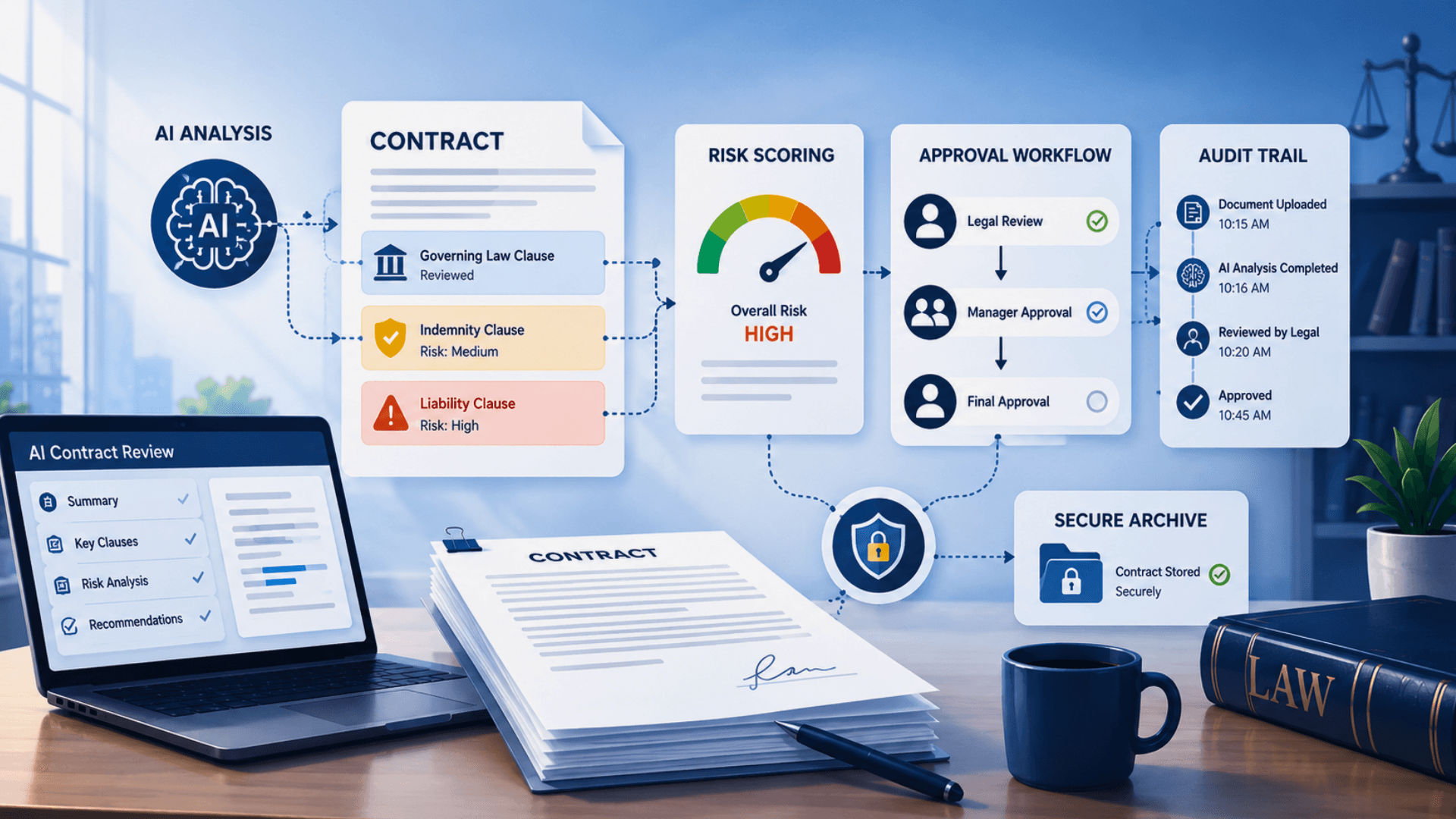
The Big Shift Nobody Talks About
AI contract review used to be a speed game.
The best tools were the ones that could summarize faster, rewrite clauses cleaner, and produce redlines that looked "close enough." That era is ending.
Legal teams are now choosing tools based on whether they can support governance, not writing.
Instead of asking, "Can this tool rewrite my indemnity clause?", teams now ask:
- Can we track what the AI changed?
- Can we log who approved the output?
- Can we prove the review process if a dispute happens later?
- Can we control who can export or edit sensitive contracts?
That's a major shift in how legal AI is evaluated.
Why Drafting Speed Isn't Enough Anymore
Contract review is not a creative task. It's a risk-heavy workflow.
If AI produces a weak clause and the business signs it, the problem isn't only the AI output. The bigger issue is that nobody can prove how the decision was made.
That is why legal teams are now prioritizing:
- audit logs and activity tracking
- role-based access controls
- version history and export tracking
- risk scoring instead of "general summaries"
- escalation workflows for high-risk agreements
This isn't about writing better contracts.
It's about building workflows that hold up under scrutiny.
Where This Hits First
This shift affects anyone handling contracts at scale, especially:
- Legal Ops teams building standardized workflows
- In-house counsel handling procurement agreements
- Compliance teams responsible for audit readiness
- Procurement and vendor management teams
- Law firms reviewing high volumes of commercial contracts
- Risk managers handling cross-border obligations
Workflow Actions (Legal Teams)
1) This Week: Map Your Contract Review Like a Pipeline
Write down your review process as a simple flow.
Example:
-
Intake → clause review → risk tagging → redlines → approval → signature → storage
-
Then mark exactly where AI currently touches the workflow.
-
If AI is generating language at a stage where approvals are unclear, fix that immediately.
2) This Month: Build a Risk-Based Review Track
-
Not every contract needs the same treatment.
-
Split agreements into categories:
- Low-risk: NDAs, renewals, standard templates
- Medium-risk: vendor contracts, service agreements
- High-risk: liability-heavy terms, DPA, regulated contracts
Then define where AI can assist, and where human approval becomes mandatory.
This is how legal teams move faster without gambling on risk.
3) This Quarter: Make Audit Trails a Vendor Requirement
Stop evaluating legal AI tools like writing software.
Instead, require governance features such as:
- export logs and full version history
- permission controls
- approval checkpoints
- risk tagging + escalation routing
- secure storage and retention controls
If a vendor cannot support these features, the tool is not "enterprise-ready," no matter how impressive the output looks.
The Real Takeaway
-
AI contract review is no longer a productivity feature. It is becoming a governance system.
-
Teams that treat legal AI as drafting support will eventually hit the same wall: unclear approvals, missing logs, and no defensible record of decision-making.
-
The teams that win will be the ones who treat AI as part of compliance infrastructure, not as a shortcut.
Sources & References
Insight Sources
Verified By
GuideToReviews Team
Need a custom AI tool recommendation?
Our AI Assistant tracks the latest mergers and updates to recommend the best tools for your specific workflow.