
Legal AI Is Moving Toward Audit-Ready Workflows Instead of “Black Box” Answers
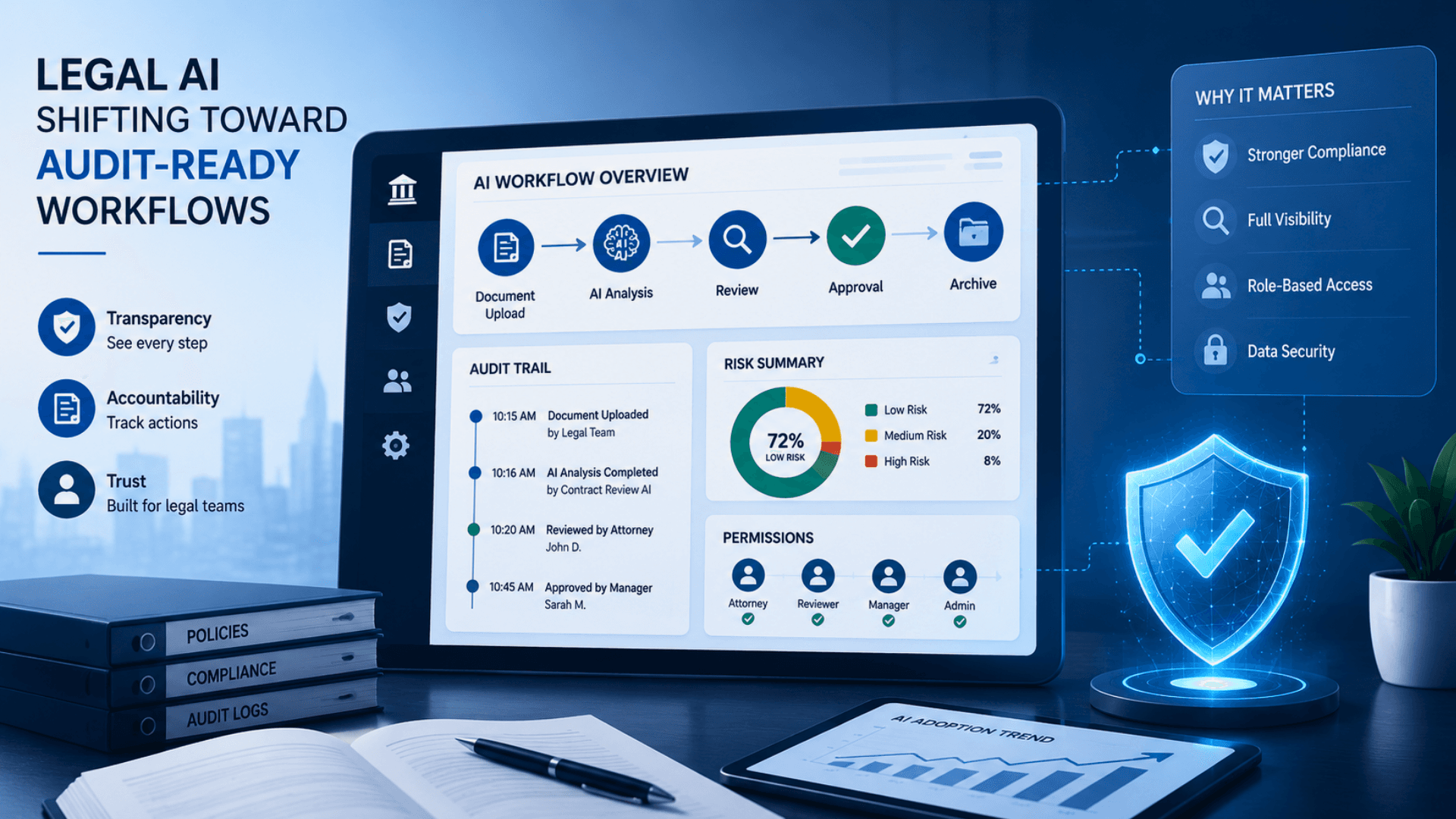
The legal AI market is shifting away from "fast answers" toward systems that can prove accountability.
Legal AI used to sell itself as a shortcut.
If it produced a reasonable summary or a confident answer, many teams accepted it and moved on.
That's changing.
The legal market is starting to demand something different: traceability.
Teams want to know:
- What was uploaded?
- Who accessed the document?
- What did the AI output?
- Who approved the output?
- What changed between draft and final?
This shift is accelerating because legal AI has stopped being experimental. It's become part of daily operations — and once something becomes operational, it becomes auditable.
Why This Shift Is Accelerating Right Now
Three pressures are driving it:
- Regulation is catching up. Governments are drafting AI accountability frameworks. Even where these laws don't directly target contract review tools, they raise the bar on transparency across the board.
- Clients are asking tougher questions. Law firms and in-house teams are facing sharper client scrutiny. Many clients now want to know whether AI touched the work and how someone validated it.
- Internal risk teams are paying closer attention. AI mistakes in legal workflows aren't just tool errors — they become liability exposure.
Together, these pressures are turning governance features from a nice extra into a baseline requirement.
What You'll See Next in Legal AI Tools
Over the next 12 months, expect legal AI vendors to compete on:
- Built-in audit trail exports
- Permission controls and admin dashboards
- Structured review workflows
- Human approval checkpoints
- Compliance reporting features
The tools with the flashiest demo won't win this round. The tools that can survive an internal audit will.
Workflow Actions
Immediate
Ask every vendor one direct question:
"Can your platform export a full audit log of AI usage and approvals?"
If they can't answer yes, treat the tool as high risk.
Short-Term
Split AI usage into two categories:
- Low-risk: drafting assistance, summaries, formatting
- High-risk: compliance analysis, legal reasoning, liability clauses
Build your governance rules around that distinction.
Scale
Put together a governance checklist covering every legal AI tool you adopt:
- Retention policy
- Access permissions
- Audit export requirements
- Escalation rules for high-risk agreements
Where This Is Heading
Legal AI is trading "smart answers" for accountable workflows.
The market no longer settles for output quality alone — it wants proof of how the system reached its decision.
Legal teams that build audit-ready workflows now will move faster later. Teams that skip this step will end up rebuilding under pressure instead.
Sources:
- Corporate legal AI adoption and 2026 governance trends: Legal Chain — Legal AI Trends 2026
- Law firm AI compliance obligations, ABA Formal Opinion 512, and state/EU regulatory overlap: Clio — AI Legal Compliance for Law Firms
- AI audit trail requirements across regulatory regimes (EU AI Act, HIPAA, SOX-adjacent frameworks): Kognitos — AI Audit Trail Requirements 2026, DeepInspect — AI Audit Trail Requirements by Regulation
- Audit-trail quality standards and legal work-product considerations: Ares Legal — Audit Trail Requirements
Verified By
GuideToReviews Team
Need a custom AI tool recommendation?
Our AI Assistant tracks the latest mergers and updates to recommend the best tools for your specific workflow.